
Power, Heat, and the Grid – AI’s Physical Limits
Every concept explored in the first three articles of this series – the GPU cluster, the AI factory, and the financial structures now supporting hyperscale AI infrastructure – ultimately converges on a single physical reality: electricity.
AI, at the scale now being pursued globally, is among the most energy-intensive digital technologies ever deployed. The International Energy Agency (IEA) reports that electricity demand from data centres grew by approx. 17% in 2025 alone, while demand from AI-focused facilities increased even faster. The infrastructure required to train and serve AI models is reshaping electricity grids, influencing site selection decisions, and forcing the industry to rethink its relationship with energy – not simply as a utility cost, but as a strategic resource.
For much of the data centre industry’s history, discussions around power largely focused on resilience and redundancy. Today, power availability is increasingly a determining factor in whether AI infrastructure can be built at all.
The question is no longer simply whether a market has demand for AI infrastructure. It is whether it can provide sufficient, reliable, and affordable power to support it.
For the GCC, this carries particular significance. The Guld is among the world’s most energy-rich regions, with sovereign control over substantial power generation capacity and the financial resources to expand it. At the same time, it faces challenges associated with extreme temperatures, water scarcity, and a rapidly growing domestic electricity demand.
As AI infrastructure expands, these factors are becoming central to how the region competes for investment.
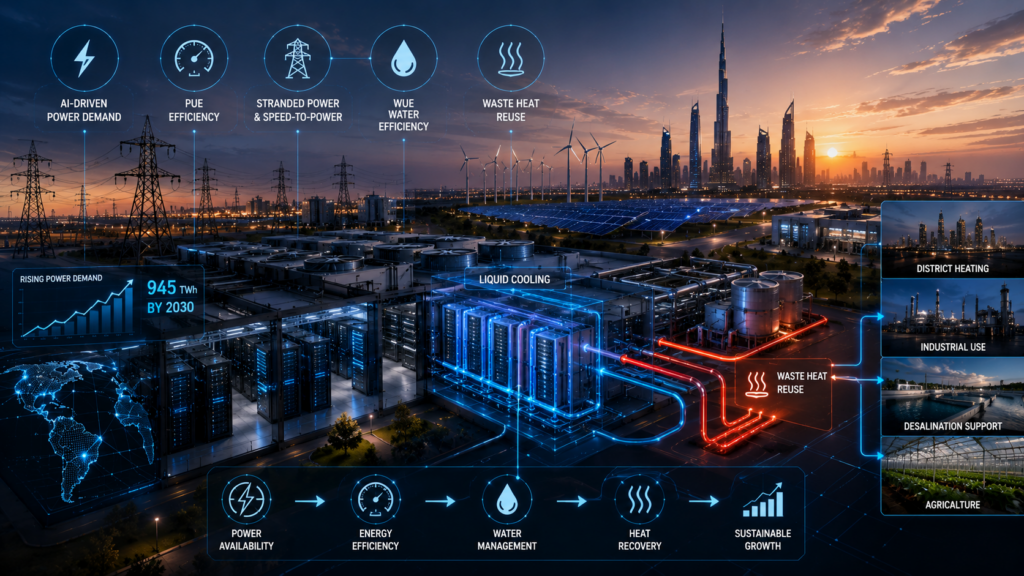
This article explores the five concepts now sitting at the centre of the AI infrastructure conversation: AI-driven power demand, Power Usage Effectiveness (PUE), stranded power and power procurement, Water Usage Effectiveness (WUE), and waste heat reuse.
Why power has become the new currency of AI?
For decades, data centre location decisions were driven primarily by connectivity.
Developers looked for access to fibre routes, internet exchanges, cloud on-ramps, and concentrations of enterprise customers. Power was important, but it was generally assumed to be available.
AI is changing that equation.
Increasingly, the first question asked by developers, hyperscalers, and investors is not where fibre exists, but where power exists.
Access to large volumes of reliable electricity, delivered at the right price and on the right timeline, is becoming one of the industry’s most important competitive differentiators.
In many established markets, the challenge is no longer finding land, customers, or capital. It is finding power.
This is why conversations around grid capacity, transmission infrastructure, renewable energy procurement, and even nuclear power have moved from specialist discussions to boardroom priorities.
AI infrastructure is fundamentally an exercise in converting electricity into intelligence. The more AI scales, the more valuable power becomes.
In many respects, electricity is emerging as the new currency of AI.
- AI-Driven Power Demand
What is it?
Ai-driven power demand refers to the additional electricity consumption created by the rapid expansion of AI infrastructure, including GPU clusters, training environments, inference platforms, cooling systems, and supporting network equipment.
The scale of this demand in substantial.
The IEA projects that global electricity consumption from data centres will reach approx. 945 Twh by 2030, driven largely by the growth of AI workloads. To put that into perspective, that level of consumption would exceed the annual electricity demand of many developed economies.
At the facility level, the scale is equally striking. Several AI-focused campuses currently under development are designed to consume 500MW or more from the grid at a single location. Only a few years ago, this level of demand would have been associated with major industrial facilities rather than digital infrastructure.
Why is matters for infrastructure?
The rise of AI power demand is fundamentally changing the relationship between data centres and energy infrastructure.
In the past, most facilities connected to the grid in much the same way as other commercial developments. Utilities provided the power, operators paid for it, and the relationship was relatively straightforward.
AI infrastructure at the hyperscale level changes that model.
A 500MW AI campus cannot simply connect to existing infrastructure and begin operating. Facilities of this scale may require new substations, transmission upgrades, dedicated grid investments, and years of planning between operators, utilities, regulators, and governments.
Increasingly, the relationship between a hyperscaler and a utility resembles a long-term industrial partnership rather than a traditional customer relationship.
The impact extends beyond conventional grid infrastructure. AI operators are becoming some of the largest buyers of renewable energy globally and are increasingly exploring alternative power sources, including advanced geothermal technologies and next-generation nuclear energy.
One particularly notable trend is the growing interest in Small Modular Reactors (SMRs). Industry estimates suggest that the pipeline of conditional power agreements between data centre operators and SMR projects has expanded from roughly 25GW to 45GW in little more than a year, reflecting the industry’s search for reliable long-term power solutions.
For the GCC, these developments intersect with broader energy transitions already underway. All 6 GCC countries are all pursuing different combinations of renewable energy expansion, grid modernisation, industrial growth, and digital infrastructure development.
The challenge is no longer simply generating electricity. It is ensuring that sufficient power can be delivered to the right locations, at the right scale, and on the right timeline.
- Power Usage Effectiveness (PUE)
What it is?
Power Usage Effectiveness (PUE) is the most widely used energy efficiency metric in the data centre industry.
The metric compares the total power consumed by a facility with the power consumed directly by the IT equipment operating within it.
A theoretical PUE of 1.0 would mean that every watt entering the facility is used directly for computing, with no overhead for cooling, lighting, power conversion.
In reality, modern facilities typically operate at higher values, with lower scores generally indicating greater efficiency.
For many years, PUE became the industry’s preferred benchmark because cooling represented one of the largest sources of non-IT energy consumption.
Why it matters for infrastructure?
PUE remains a useful metric, but AI infrastructure is exposing some of its limitations.
The most important point is that PUE measures facility efficiency, not compute productivity.
A data centre can achieve an excellent PUE while delivering relatively little useful AI work. Equally, a highly utilised AI environment may consume substantially more power overall while generating significantly greater value from every watt used.
In other words, PUE tells us how efficiently a building operates. It does not tell us how effectively the compute inside that building is being used.
As AI workloads drive higher utilisation rates, operators and investors are increasingly looking beyond PUE alone when evaluating infrastructure performance.
AI is also changing how facilities are cooled.
Traditional facilities relied heavily on air cooling (AC), whereas many AI deployments now are adopting liquid cooling (LC) technologies that remove heat directly from chips and high-density servers.
As LC become more common, some of the overheads that PUE was originally designed to measure become proportionally less significant, even as overall facility power consumption continues to increase.
For GCC operators, this dynamic is particularly important.
Facilities in cooler climates can often take advantage of free-air cooling for significant portions of the year. In the Gulf, high ambient temperatures make cooling far more challenging and place greater emphasis on efficient cooling architectures.
As a result, LC is increasingly becoming a strategic requirement for AI deployments in the region rather than simply an efficiency enhancement.
- Stranded power, power procurement, and speed-to-power
What it is?
Stranded power refers to electricity generation capacity that exists but cannot easily be utilised because it is located for from demand centres, lacks sufficient transmission infrastructure, or has not yet attracted significant industrial activity. In the data centre industry, the term increasingly describes locations where large blocks of power are available but underutilised, making them attractive destinations for AI infrastructure development.
Power procurement refers to the broader process through which data centre operators secure electricity supply for facilities. This can include grid connection agreements, power purchase agreements (PPAs), renewable energy procurement, dedicated generations strategies, and long-term utility partnerships.
Increasingly, however, the industry is focusing on a third concept: speed-to-power.
Speed-to-power refers to how quickly a developer can secure and energise a site. In an environment where demand for AI compute is accelerating and hyperscalers racing to deploy capacity, the timeline for accessing power has become almost as important as the power itself.
Why it matters for infrastructure?
Power availability has quietly become one of the most important site selection criteria for AI infrastructure.
Historically, data centres were often developed around connectivity hubs, enterprise demand centres, and fibre-rich locations. While these factors remain important, AI is increasingly shifting the conversation towards energy infrastructure.
In many established markets, securing power has become significantly more difficult than securing land, capital, or customers.
Grid interconnection queues continue to lengthen, transmission infrastructure is under pressure, utilities are struggling to accommodate the scale of demand now being created by hyperscale AI deployments. In several major markets, developers face waits of multiple years before sufficient capacity can be delivered to the site.
This bottleneck is reshaping the geography of AI infrastructure development in real time.
Developers are increasingly evaluating locations based less on proximity to population centres and more on proximity to power availability. Sites located near to hydroelectric generation, nuclear facilities, large renewable energy projects, and major energy corridors are becoming increasingly attractive because they offer a faster path to the energisation that congestion of established markets.
The rise of behind-the-meter-power
One of the most significant responses to growing grid constraints is the rise of behind-the-meter power strategies.
Rather than waiting several years for transmission upgrades, substation expansions, or new grid connections, some developers are choosing to secure dedicated power generation directly at or adjacent to their facilities. In these models, power is generated and consumed on-site rather than being delivered entirely through the public grid.
In practice, this often means data centres are initially powered through dedicated natural gas generation or other local energy sources before connecting to the wider grid once additional capacity becomes available. This approach is sometimes referred ro as operating in ‘’island mode’’, where the facility functions independently of the grid during its early years of operation.
The rationale is increasingly straightforward.
For many AI deployments, speed-to-power has become more valuable than immediate grid connectivity. Delaying a hyperscale AI campus by three or four or even five years while awaiting utility upgrades can carry significant commercial consequences in a market where demand for AI compute continues to outpace available supply.
As a result, behind-the-meter power is rapidly evolving from a niche solution into a mainstream infrastructure strategy. Several large-scale AI developments are now evaluating hybrid approaches that combine dedicated generation, renewable energy procurement, battery storage, and future grid integration as part of a broader effort to accelerate deployment timelines.
While some view these approaches as temporary bridging solutions, others increasingly see them as part of a longer-term shift towards more flexible and resilient energy strategies for AI infrastructure.
Why this matters for the GCC?
For GCC markets, these developments are broadly favourable.
The region benefits from large-scale generation capacity, sovereign control over significant energy infrastructure, substantial capital available for grid expansion, and long-term industrial development planning. These advantages are becoming increasingly valuable as power constraints emerge in more mature data centre markets.
At the same time, hyperscalers and AI infrastructure operators are becoming increasingly sophisticated energy buyers. Many maintain ambitious sustainability targets, operate extensive renewable energy procurement programmes, and require long-term certainty around power availability and pricing.
For GCC utilities, regulators, and policymakers, this means that competitiveness is no longer determined solely by the cost of electricity.
Increasingly, it is determined by the ability to provide scalable power, transparent procurement frameworks, regulatory certainty, and, perhaps most importantly, speed.
In the AI area, power is becoming a strategic differentiator.
And in many cases, the markets that can deliver power fastest may prove more attractive than those that can simply deliver it cheapest.
- Water Usage Effectiveness (WUE)
What is it?
Water Usage Effectiveness (WUE) measures the amount of water consumed by a data centre relative to the energy delivered to its IT equipment.
Where PUE focuses on energy efficiency, WUE focuses on water efficiency.
Historically, water consumption received far less attention than power consumption in discussions around digital infrastructure. In many regions, water was relatively abundant and therefore viewed as a strategic constraint.
AI is changing that.
As facilities become denser and cooling requirements increase, water is becoming a more important consideration in both infrastructure planning and sustainability discussions.
This is particularly true for facilities that utilise evaporative cooling systems or cooling towers, both of which require significant volumes of water to operate efficiently.
Why it matters for infrastructure?
For GCC markets, water management is not a secondary issue. It is a core infrastructure consideration.
The region is one of the most water-stressed areas in the world and relies heavily on desalination to meet domestic and industrial demand, making water consumption intrinsically linked to energy consumption.
This creates an important dynamic for AI infrastructure.
In many cases, using large volumes of desalinated water for cooling does not simply create a water challenge. It creates an additional electricity challenge because desalination itself is energy intensive.
In effect, inefficient water use can indirectly increase the overall energy footprint of a facility.
As a result, many operators are increasingly exploring cooling approaches designed to minimise water consumption. Closed-loop liquid cooling systems, dry cooling technologies, and hybrid cooling architectures are all receiving growing attention as AI deployments become larger and denser.
The investor perspective is also evolving. Just as institutional investors and hyperscalers increasingly scrutinise carbon intensity and power efficiency, water efficiency, is becoming a more prominent part of environmental due diligence.
For GCC operators seeking hyperscale customers or international partners, demonstrating credible water management is increasingly becoming both an operational requirement and a commercial advantage.
In the years ahead, discussions around AI infrastructure in the Gulf are likely to focus not only on how efficiently facilities use electricity, but also on how responsibly they use water.
- Waste heat reuse
What is it?
Almost every watt of electricity entering a data centre ultimately becomes heat. As AI infrastructure scales, facilities are becoming significant producers of thermal energy.
Waste heat reuse refers to the process of capturing that heat and using it productively rather than simply rejecting it into the atmosphere.
The concept itself is not new. Data centres have explored heat recovery for years. What is changing is the scale of opportunity.
As AI facilities become larger and LC becomes more common, operators are gaining access to higher-quality thermal output that can potentially be reused across a range of applications.
Why it matters for infrastructure?
Waste heat reuse is gradually evolving from a sustainability initiative into a broader infrastructure opportunity.
Some of the most advanced examples can already be found in Northern Europe: Microsoft’s data centre region near Helsinki, developed in partnership with Finnish utility Fortum, is expected to provide enough recovered heat to meet a significant proportion of local district heating demand once fully operational.
Similarly, Amazon’s participation in Ireland’s Tallaght District Heating Scheme has demonstrated how data centre heat can be integrated into existing urban energy systems, reducing emissions while creating additional value from infrastructure that would otherwise be wasted.
These projects highlight an important shift in thinking. Increasingly waste heat is being viewed not as a by-product but as a usable resource.
For the GCC, the opportunity looks different.
District heating is unlikely to become a major driver of reuse economics in a region characterised by high temperatures. However, district cooling systems, industrial processes, controlled-environment agriculture, and desalination support systems all represent potential long-term applications.
The concept remains at an earlier stage in the Gulf that it does in parts of Europe. Nevertheless, the principle remains relevant.
As AI campuses grow larger and denser, the amount of thermal energy being generated will continue to increase.
Over time, operators that can find productive uses for that heat may benefit not only from sustainability gains, but from improved operational economics as well.
Not every facility will have a viable heat reuse opportunity nearby, and the commercial viability of projects will remain highly dependent on location and surrounding infrastructure.
However, as AI infrastructure continues to mature, waste heat is increasingly becoming part of a broader conversation around energy efficiency, resource utilisation, and infrastructure optimisation.
What This Means for the GCC
Taken together, these trends reveal a broader reality.
The future of AI infrastructure is increasingly being shaped by energy systems.
The industry’s focus is shifting from simply deploying compute capacity to securing the power, cooling, water, and supporting infrastructure required to operate that capacity sustainably and at scale.
For the GCC, this presents both opportunity and challenge.
The region possesses many of the ingredients required to become a major global AI infrastructure hub. Large-scale energy resources, sovereign investment capital, expanding renewable energy programmes, strategic government backing, and growing digital economies all provide strong foundations for future growth.
The recently announced UAE-US AI Campus, with plans for up to 5GW of AI infrastructure capacity, illustrates the scale of ambition now emerging across the region.
Saudi Arabia’s sovereign AI initiatives, the UAE’s investments in advanced computing, and wider Gulf ambitions around digital transformation all point toward a future in which AI infrastructure plays an increasingly important economic role.
Yet access to capital alone will not determine success.
The most competitive markets will be those capable of delivering power at hyperscale scale and speed, managing cooling efficiently in extreme climates, minimising water consumption, and providing long-term certainty around energy procurement.
The Gulf’s energy advantages are significant, but they must be translated into practical infrastructure outcomes.
Ultimately, AI infrastructure is becoming an increasingly integrated part of wider energy, industrial, and economic planning.
The regions that understand this relationship most clearly are likely to be the regions that capture the greatest share of future investment.
Conclusion
Throughout this AI Decoded series, we have explored the evolution of AI infrastructure from several different perspectives.
Article 1 introduced the terminology shaping today’s AI conversations.
Article 2 examined how AI is transforming the physical design of data centres through GPU clusters, liquid cooling, and AI factories.
Article 3 explored the economics underpinning this growth, explaining how unprecedented capital requirements are changing the way digital infrastructure is financed.
This article has focused on the physical constraints that sit beneath all of those developments.
Power, heat, water, and energy infrastructure are no longer secondary considerations. They are increasingly the foundations upon which AI infrastructure is built.
The GPU cluster, the AI factory, the sovereign AI programme, and the hyperscale training campus all ultimately depend on one fundamental requirement: the ability to deliver electricity at scale and manage its consequences efficiently.
Where that capability exists, AI investment is likely to follow.
Where it does not, even the most ambitious projects can face significant constraints.
For the GCC, this creates a compelling opportunity.
The region possesses many of the resources required to become a major AI infrastructure destination. However, success will depend on more than capital investment or policy ambition alone.
It will depend on how effectively Gulf markets can deliver power, manage heat, optimise water use, and build the supporting infrastructure required for the next generation of AI.
The physical limits of AI are not obstacles that can be ignored.
They are infrastructure challenges that must be understood, planned for, and solved.
The markets best positioned to succeed in the AI era will not simply be those that deploy the most compute.
They will be those that understand the relationship between compute, energy, and infrastructure most effectively – and build accordingly.