
When the Backbone of the Internet Falters
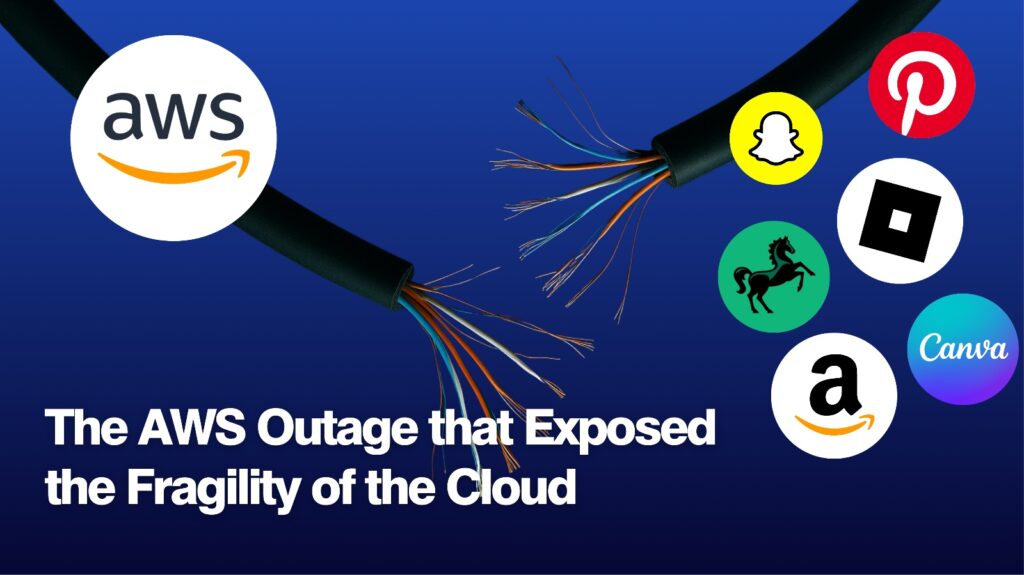
On Monday, AWS, the world’s largest cloud provider, suffered a DNS failure in its US-East-1 region in Virginia – its oldest and most critical data centre cluster.
For around 15 hours, a simple misconfiguration caused widespread disruption, affecting services like Snapchat, HMRC, Roblox, Canva, Lloyds Bank, and even parts of Amazon’s own operations. More than 2,000 companies and millions of users were impacted. It was, in essence, the digital equivalent of the lights going out in half of the world’s cities – a vivid reminder that the cloud, despite its name, is a very physical, highly centralised system.
It is (Almost) Always DNS
Although often underestimated, DNS issues are frequently at the heart of major outages, as Monday’s event demonstrated.
The Domain Name System (DNS) acts like the internet’s phonebook, directing users to the right servers when they tap and app or visit a website. When AWS’ DNS systems in Virginia went down, the servers themselves were still running, but nothing could find them.
This was not AWS’ first outage in Virginia. The same region has suffered three major outages in the last five years and now carries roughly 70% of the world’s internet traffic. This raises the question of why so much of the internet’s backbone remains concentrated in a single region?
The Centralisation Problem
AWS, Microsoft, and Google together now operate about 60% of global cloud computing infrastructure. Their data centres provide the invisible infrastructure for social media and e-commerce, public services, healthcare, and financial systems.
This consolidation brings efficiency – scale lowers costs and speeds up innovation – but it also introduces single points of failure. When one region falters, authentication, routing, and data storage for thousands of systems can go offline in seconds.
As one industry commentor put it: ‘’We’ve put too many of our digital eggs in one basket’’. Yet, for many organisations and countries, there simply are not enough baskets to choose from.
Beyond Outage: The Sovereignty Debate
The outage reignited the important conversation that goes beyond AWS itself: digital sovereignty. Across Europe, the UK, and even the Middle East, governments and regulators are asking difficult questions:
- What happens when a foreign-owned service underpins essential national systems and fails?
- How can nations ensure continuity of digital operations in a crisis?
Some argue that open standards, not ownership, are the solution, giving flexibility without duplicating the big players’ infrastructure. Others insist that true sovereignty means the ability to operate independently.
Initiatives like Europe’s Gaia-X and Stackit are early attempts at building ‘’sovereign clouds’’ – locally controlled infrastructures that keep data, governance, and accountability with national or regional borders. Adoption remains limited, but urgency is growing. As one report put it, cloud computing has become the ‘’power grid of the 21st century’’, essential to every aspect of modern life, yet largely outside national control.
The Lessons: Rethinking Resilience
Resilience is not something that can be achieved through regulation or ownership alone; it must be designed into the system. This means:
- Distributed architectures, so that one region’s failure does not bring down the whole network
- Multi-cloud strategies, to avoid single points of dependency
- Robust failover systems, to automatically reroute traffic when something breaks
Beyond technical resilience lies strategic resilience, ensuring that nations and organisations are not wholly dependent on the uptime and goodwill of a handful of US-based corporations. Cloud reliability has become a matter of national security, economic stability, and strategic autonomy.
Final Thought
The AWS outage served as a reminder that even the most advanced cloud systems are still bound by the realities of geography, infrastructure, and ownership. It highlighted how interdependent our digital world has become. The discussion is now about understanding and managing the risks of concentration.
—
Want more insights on the GCC data centre market? Keep an eye out on our Events page to see where we’ll be taking the next GDCA event, and watch out on our Publications page for the launch of our latest reports.